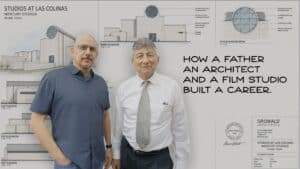
It was written into the design of the building I’ve worked in for sixteen years. I just didn’t really appreciate how much my father helped write it. Until now.
My dad had a habit on the road.
We’d be driving somewhere — through Fort Worth, through Dallas, somewhere in between — and he’d go quiet for a moment. Then he’d point at something through the windshield. A building. A bridge. A structure most people drove past without a thought.
“Look at that,” he’d say.
And then he’d describe it in a language I didn’t yet have words for. The way the entrance invited you in without announcing itself. The relationship between the material and the light. The detail someone decided to include not because it was required, but because it made the whole thing more honest. He had a name for what most people walked past: purpose. Harmony. Form earning function.
I was a kid. I didn’t know I was getting an education.
The building I’ve worked in for the past sixteen years was designed by the firm my father worked for.
Fred Fernandez spent his career as an architect — including years at Growald Architects here in DFW — and one of the projects that came through that office was the Dallas Communications Complex on Riverside Drive in Irving. What became the Studios at Las Colinas. What is now Mercury Studios, where CRM Studios has been headquartered since 2009.
I knew this building long before I worked in it. RoboCop, JFK, Walker, Texas Ranger were all shot on these stages. The building had a full life before I arrived.
At one point, years into my career, I found myself not as crew but as part of a production shooting inside Studio B. I’d worked on plenty of sets before — mostly behind the camera, in some crew capacity. You learn quickly that a working film set is its own universe: full of life, full of intention, every element pointed at the story being told. But being in front of the camera is different. When you’re crew, you’re building the world. When you’re in it — playing a role, participating in the action — you’re living inside a world someone else designed. It puts you in a different mindset entirely. You’re not watching the experience get assembled. You’re walking in someone else’s shoes, inside a space built to make that possible.
That stage did exactly what Growald built it to do. Transport you somewhere else. I just didn’t have the language for it yet.
You stop seeing what surrounds you every day.
I worked in this building for years before I thought much about the building itself. What I kept thinking about was my dad’s habit.
Those drives through DFW. The way he’d spot something most people missed and hold it up to the light — not to impress, but because he genuinely couldn’t let it pass. He didn’t talk about design in terms of aesthetics alone. For him, every element had to earn its place. Natural flow. Harmony between form and function. Nothing added for the sake of character — it had to serve something real.
“The original is always better than the copycats,” he told me once. And within that purposeful constraint, he found ways to make it beautiful. Precise and pleasing at once.
I’ve been describing content strategy in almost identical terms for thirty years.
Every frame earns its place. Strategy and aesthetics aren’t separate conversations. The system has to flow — from discovery to production to distribution to measurement — the way a well-designed building flows, where nothing is gratuitous and everything points somewhere. You don’t add a visual flourish because it looks impressive. You add it because it serves the message.
I never consciously drew that line between us. The word “Architect” showed up in how I describe what I do the way my dad’s philosophy showed up in how I work — not as a choice, but as a recognition. It was always already there.
My stepmom Anne is an architect too — with CHS Architects, a firm whose work is threaded through DFW in ways most people move through without noticing. She designed the AMS Productions studio building, which happens to be where I started my career, about eight months after graduating from UT Austin. I’d worked on a couple of made-for-TV film projects in Austin and Seattle first, then came back to DFW and started in a building her firm had designed.
Fred’s firm built the building where I’d spend the back half of my career. Anne’s firm built the building where it started.
I’ve been working inside my family’s architecture the entire time.
Martin Growald, who ran the firm my dad worked for, believed an architect’s job was to transport a client “two or three or four years into the future” — show them what bold looks like before they’re ready to ask for it. When he designed the Dallas Communications Complex, the intent was documented: “intrigue was always a part of the strategy.” A building designed to tell a story before anyone walked through the door.
He built that into the walls. My dad worked inside that design culture for years. I’ve been applying the same principle to content systems ever since — from a building that was built to do exactly that.
He visited the studio recently. I walked him through the spaces — some transformed, some exactly as he knew them. He was quiet in the way people get when they’re remembering something they made.
I sat him down, put him on camera and asked him what he saw when he was drawing this place — and whether any of it turned out the way he imagined.
You can watch that interview below.
But standing here now, in a building his firm designed, doing work that runs on principles he quietly gave me — I understand something I didn’t have language for before.
I didn’t choose “The Architect” as a brand metaphor.
It chose me.